 time → · kHz ↑ · night in depth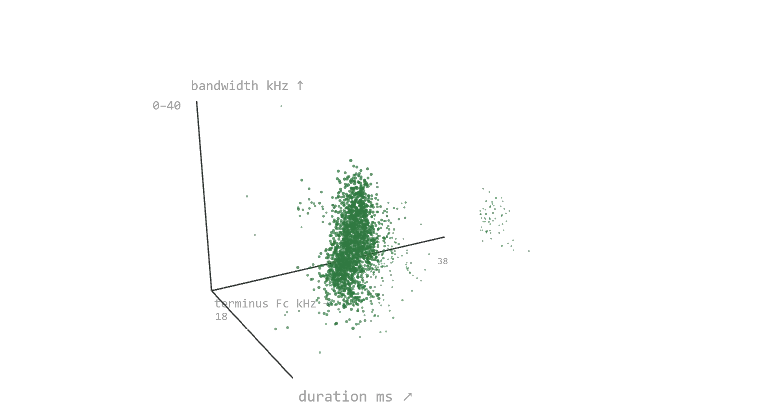
Bioacoustics · Denver · June 2026
What flies over my backyard at night?
In June I mounted an AudioMoth under my patio eave and recorded overnight at 250 kHz. I wanted to find out whether bats crossed the yard and which species the recordings could support. The data points to big brown bats on most recorded nights and silver-haired bats on the two busiest. It also exposed several mistakes in my first analysis.
- Recorder
- AudioMoth · 250 kHz
patio eave, ~2 m up - Window
- June 10–27, 2026
7 nights recorded · 6 analyzed - Result
- 2 species supported
2,228 call detections · E. fuscus p ≤ 0.0018
 3.0 s → · 10–70 kHz across · dB up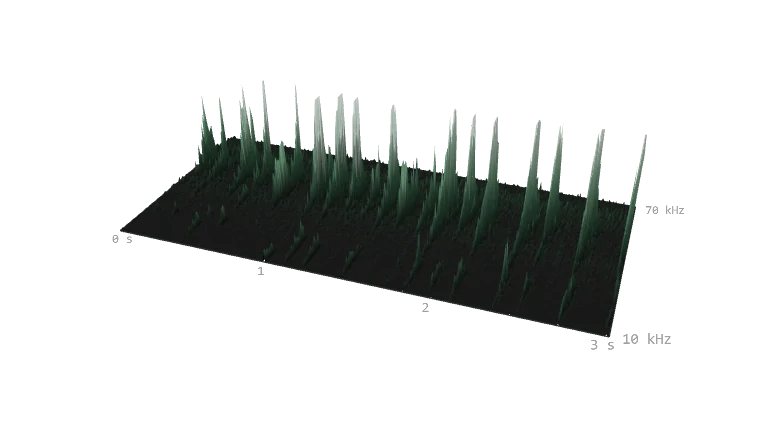
How I checked the recordings
Each full night produced 15 to 18 GB. I first flagged high-energy sound from 18 to 60 kHz, then kept the 180 loudest three-second windows from each night. Most raw flags were insects, sprinklers, or other noise.
BatDetect2 checked those clips for echolocation sweeps and measured each call. I ignored its European species labels and ran the same clips through Kaleidoscope Pro's North American classifier for species-level evidence. The AudioMoth card stayed read-only during processing.
Dusk, then before dawn
Activity clustered in the first hour after sunset and again before dawn on the two complete nights. The 4 o'clock hour on June 19 contained 435 detected calls. These counts come from sampled clips, so I use them to compare timing rather than estimate abundance.
Table view
| Night | 20:00 | 21:00 | 22:00 | 23:00 | 00:00 | 01:00 | 02:00 | 03:00 | 04:00 | 05:00 | 06:00 | Total |
|---|---|---|---|---|---|---|---|---|---|---|---|---|
| Night 1 | 1 | 155 | 17 | 0 | 0 | 46 | 2 | 8 | 0 | 0 | NR | 229 |
| Night 3 | 0 | 3 | 4 | 7 | NR | NR | NR | NR | NR | NR | NR | 14 |
| Night 4 | 38 | 70 | 57 | 0 | 3 | 29 | 0 | 0 | 0 | 0 | 0 | 197 |
| Night 5 | 0 | 47 | 68 | 50 | 39 | 12 | 60 | 30 | 435 | 123 | 2 | 866 |
| Night 6 | 14 | 84 | 43 | 72 | 44 | 5 | 53 | 15 | 287 | 233 | NR | 850 |
| Night 7 | 24 | 62 | 0 | NR | NR | NR | NR | NR | NR | NR | NR | 86 |
| Species | Night 1 | Night 5 | Night 6 | Status |
|---|---|---|---|---|
| Big brown bat E. fuscus | 5 · 0.0018 | 12 · 2.4 × 10⁻⁵ | 10 · 1.7 × 10⁻⁴ | SUPPORTED |
| Silver-haired bat L. noctivagans | 3 · 0.224 | 11 · 0.0129 | 11 · 7.8 × 10⁻⁴ | SUPPORTED Nights 5, 6 |
| Hoary bat L. cinereus | No clips · 1.000 | 5 · 0.0074 | 1 · 0.918 | REMOVED see below |
| 15 other Colorado species | 1.000 | ≥ 0.24 | ≥ 0.44 | not significant |
Kaleidoscope Pro, Bats of U.S. and Canada 5.7.0, limited to Colorado species. Night 4 returned NoID after a 13 kHz insect tone dominated pulse detection. It still needs a high-pass rerun. Night 7 has BatDetect2 output only.
What I corrected
- 06-11
Pre-dawn surge. My energy detector counted 1,618 events between 3 and 6 AM on the first night. I first read that as a large feeding bout. BatDetect2 found only eight calls in the same block, and a lower-rate recording showed sprinklers cycling on and off. I withdrew the interpretation that day.
- 06-11
21 kHz. Before using BatDetect2, I wrote a frequency tracer that repeatedly reported 21 kHz. Overlaying its traces on the spectrograms showed it slipping from the end of each sweep into noise at the filter edge. The measured sweeps ended near 26.3 kHz.
- 09-18
Hoary bat. Kaleidoscope reported hoary bat on Night 5 with p = 0.0074. I accepted that result until I reviewed the five supporting clips. Three contained flat 150 to 400 ms tones near 18 to 20 kHz, matching the sprinkler artifact. The other two looked like big brown calls. The clips did not support hoary bat, so I removed the finding.
Night 2 recorded at 48 kHz after the configuration reverted. The apparent emergence before sunset on Night 1 was me setting up the recorder. The survey ended June 27 when the batteries died. Calls are not individual animals, I sampled only the 180 loudest windows per night, and acoustic species IDs remain probabilistic. Capture or guano DNA would be needed for confirmation.
Files and tools
Review materials include batdetect_calls_n{1,4,5,6,7}.csv (229 · 197 · 866 · 850 · 86 rows), Kaleidoscope idsummary.csv files for Nights 1, 5 and 6, and the scripts scan_bats.py, run_batdetect.py, and analyze_night{3..7}.py. Processing used Python 3.11, NumPy, SciPy, and BatDetect2. The 34 GB WAV collection remains offline.
Recorded June 2026 · analysis June–July · page built 2026-09-18 · no animals handled